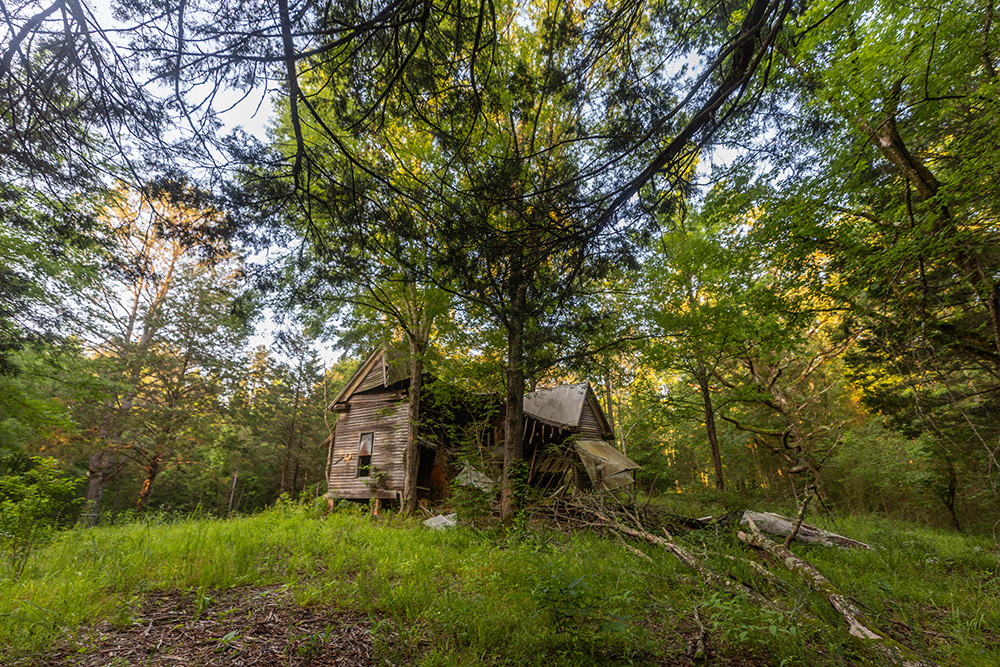
In 1938 MGM Studios bought the rights to William Faulkner’s The Unvanquished for $25,000. He soon purchased 362.5 acres of farmland east of Oxford and named it Greenfield Farm.
The previous owner, Joe Parks, had taken over the First National Bank in 1920 and supposedly forced William’s grandfather, J.W.T. Falkner, out as President. Parks would later buy Faulkner’s parent’s home on North Street and his father-in-law’s hotel on the Square. Faulkner wrote about these events in The Town. According to historian Jim Gulley, taking what would become Greenfield Farm was “not an investment. It was a trophy”.
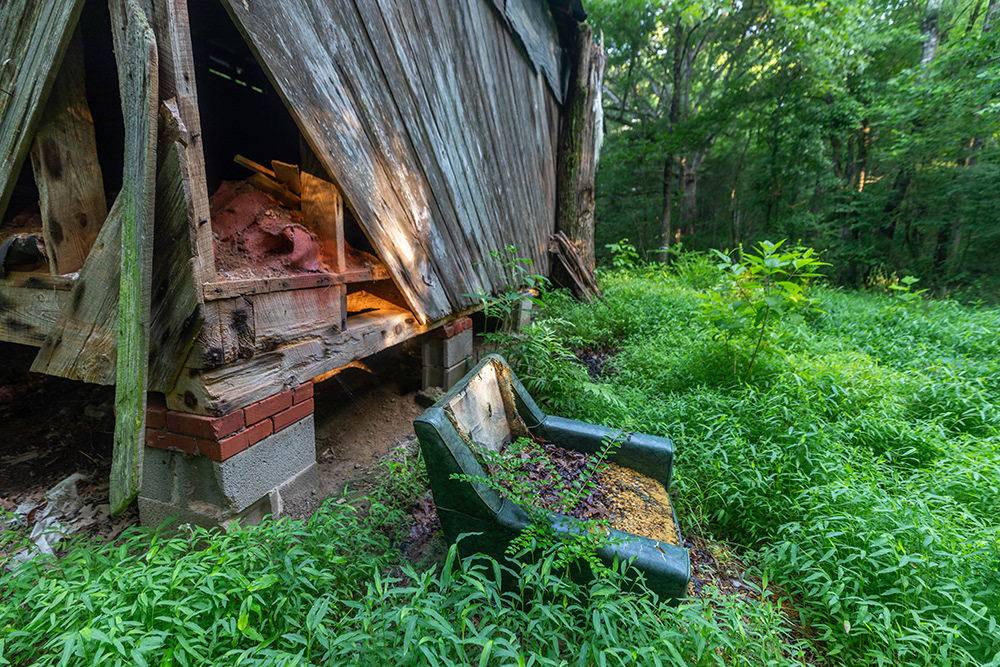
The first structure along the walkway was the corn crib, which still held a few decades-old cobs on its floors. There was a triangle-shaped hole in the northeast wall. Red insulation bled through the hole like an open wound. Below it was a decomposing chair, a blend of green leather, torn plaid fabric, and raw cushion which, when wet, looked like the innards of a creature. I photographed this chair every time I visited the farm. It gave me a subject that would hold still throughout the year and be a witness to the story of the seasons.
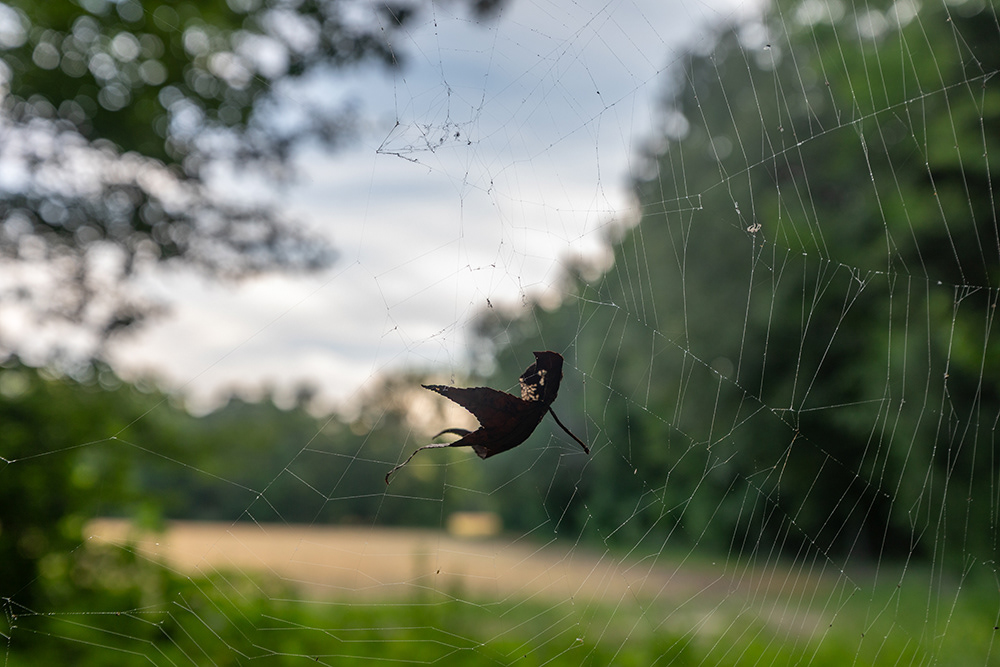
Dried Sweetgum Leaf Caught in Spider Web / June 26, 2025, 8:19 PM
I encountered little wildlife at Greenfield Farm. I heard chirping but rarely noticed a bird. I saw tracks and droppings but never spotted an opossum or deer. I never even came across a snake. While I did stumble upon spiders, I observed many more cobwebs, mostly by walking face-first into them. I marveled at the webs that caught my eye. The dew-covered ones in the morning were as beautiful as the rectangular tapestries that absorbed late day light. I found this abandoned web between the hay baler and soybean field.
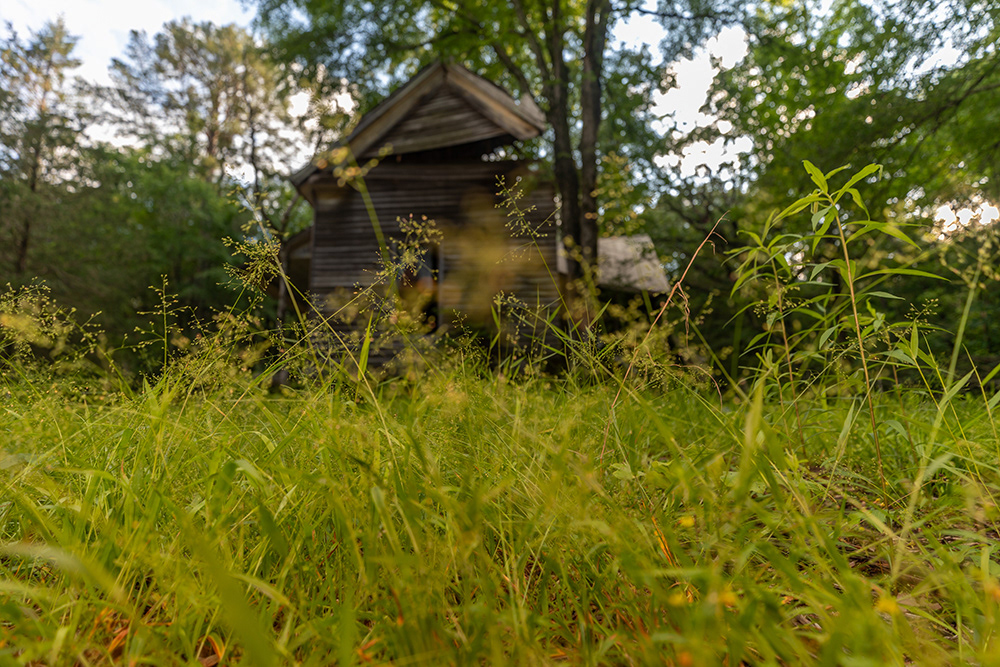
“I feel like a wet seed wild in the hot blind earth.” Dewey Dell, As I Lay Dying
By mid-May, the grasses and weeds surrounding the farmhouse were bushy. I had to walk through them to circle the dwelling. My steps stirred up pollen, and I hoped my blue jeans, tall socks, and rubber boots would block chiggers from my skin.
From a distance, when I squatted low and focused on the foreground, the east side of the farmhouse seemed almost like someone’s home. Then I noticed the detached roof and remembered, the house was broken along its spine.
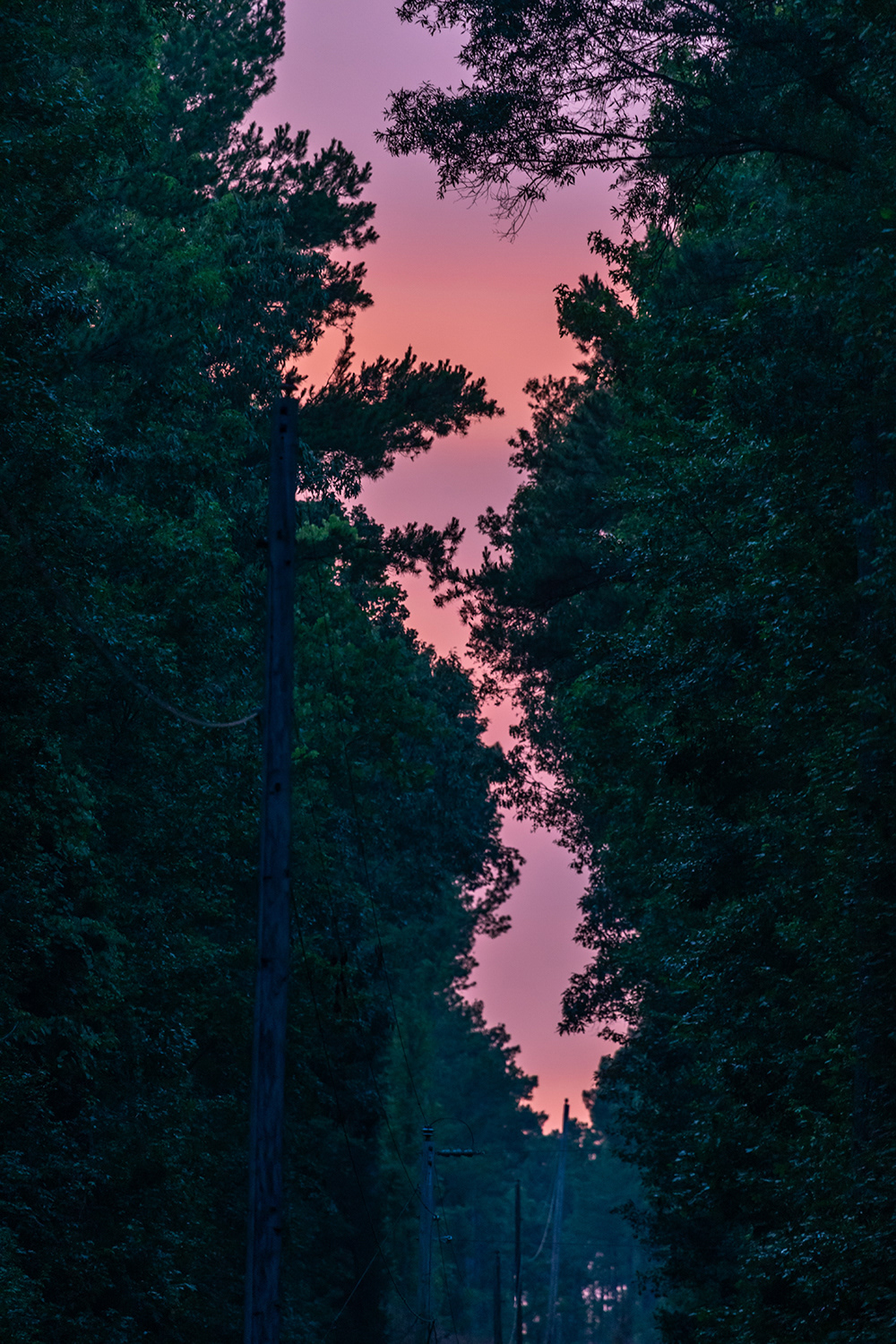
The first subjects I came upon when entering the property were utility poles. Their wires stretched across a small soybean field and rose along a hilly path that the power company cut through the woods. They were not connected to Greenfield Farm, though a dead powerline drooped across the trail near the farmhouse. These poles by the entrance served as a reminder of the outside world that seemed to vanish as I entered the walkway and approached the corn crib.
On this day, the sky was a deep pink, almost purple, that turned the utility poles blue.
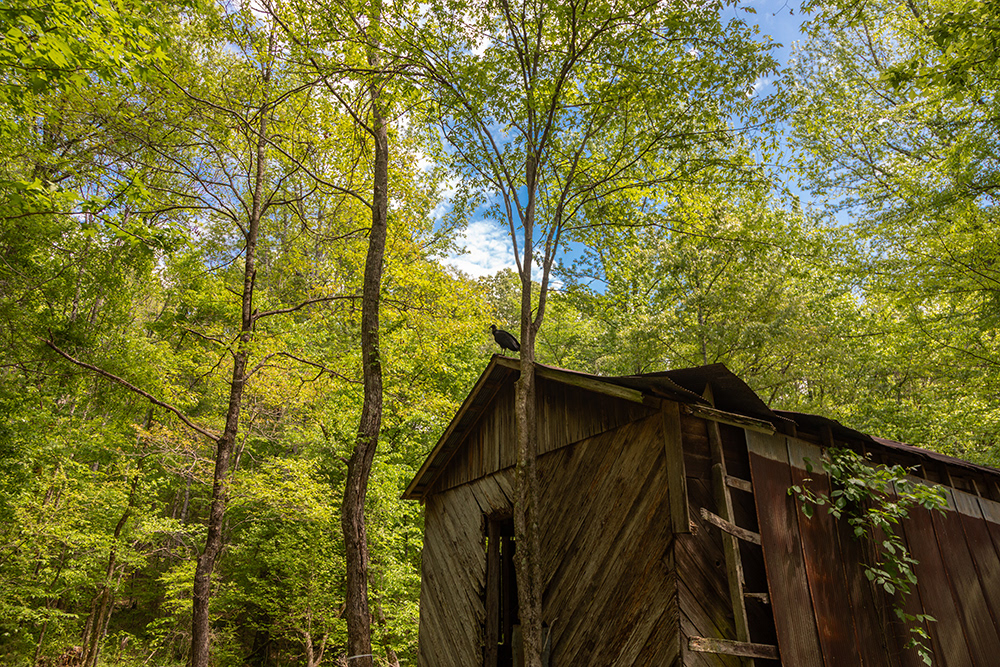
In March, I discovered that I was being watched by a black vulture. Weeks later, I was startled by its booming footsteps atop the corn crib’s tin roof. It lived there. Inside was a dustless circle on the floor where the bird rested.
John T. Edge asked me if I knew of Faulkner’s quote, “If I were reincarnated, I’d want to come back a buzzard. Nothing hates him or envies him or wants him or needs him. He is never bothered or in danger, and he can eat anything.”
Some small part of me believed the bird was Faulkner.
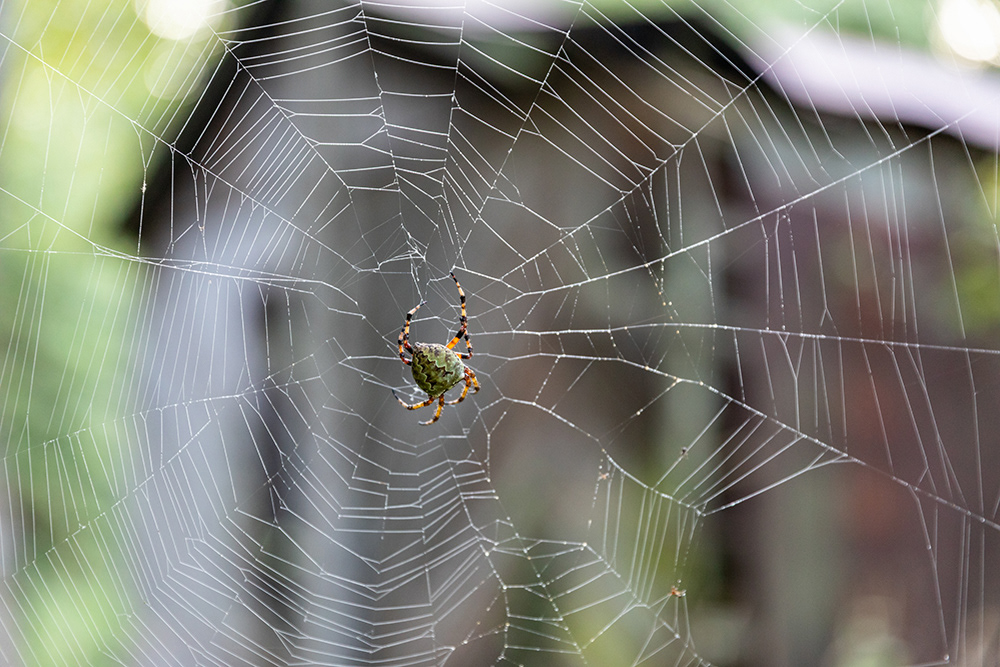
In summertime, I felt a winged insect’s buzzing fly by within seconds of exiting the car. I feared them more than the heat, so I never wore shorts or short-sleeve shirts, not even in late July. I hoped bug spray would keep the mosquitos, gnats, and horse flies away from my hands and face. Many visits they swarmed me. Greenfield Farm is a rich hunting ground for spiders, like this giant lichen orb weaver, one of the largest spiders in North America. The spider constructed the web between the corn crib and the walkway.
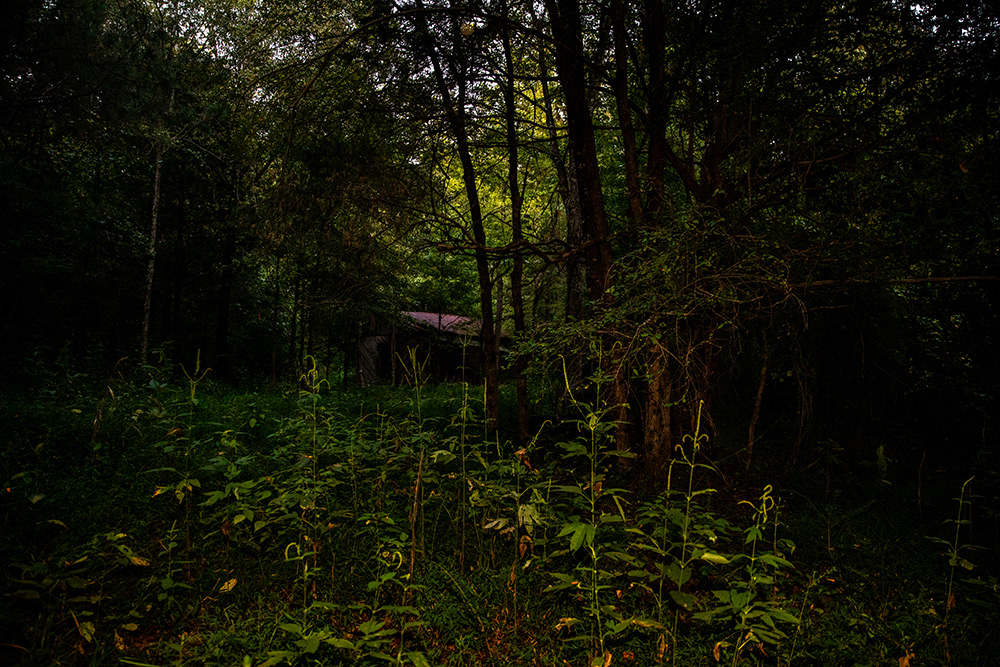
In the summer, the layers of leaves expanded the reach of the trees while the tall grasses and giant weeds swelled into what could seem like walls. I felt that compression as a darkness. Crickets created a hypnotic, panoramic sound that my ears could feel, the way my lips could feel the sweat rolling down my face. In the distance stood the corn crib, light shining on its roof. Beyond the structure, the creek that reached across the property was dry, exposing intertwined tree roots and a sandy bed until winter.
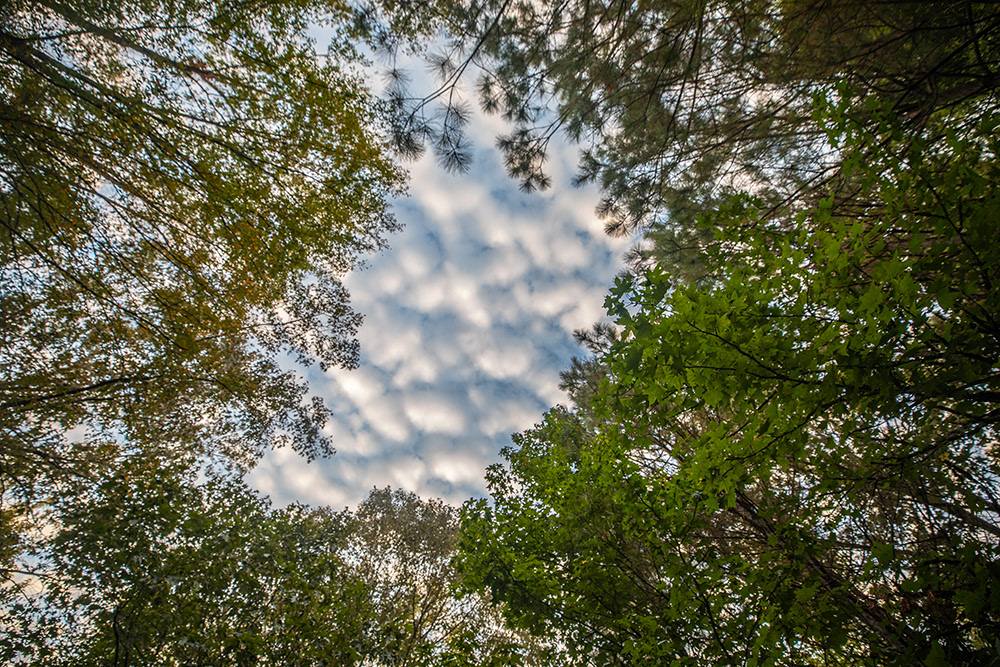
I live close to Greenfield Farm. I’d sometimes see a rich red sky at home and drive the six or so miles to capture it from the property. Most times, I was disappointed to find a pale yellowy-blue sky instead. It was strange. I became convinced the difference was connected to the hills. But I was always mindful of the sky and captured color and clouds when they wanted to play. I love the altocumulus clouds in this image. They moved as one, like a river, and their layers seemed to mimic those of the leaves on the trees.
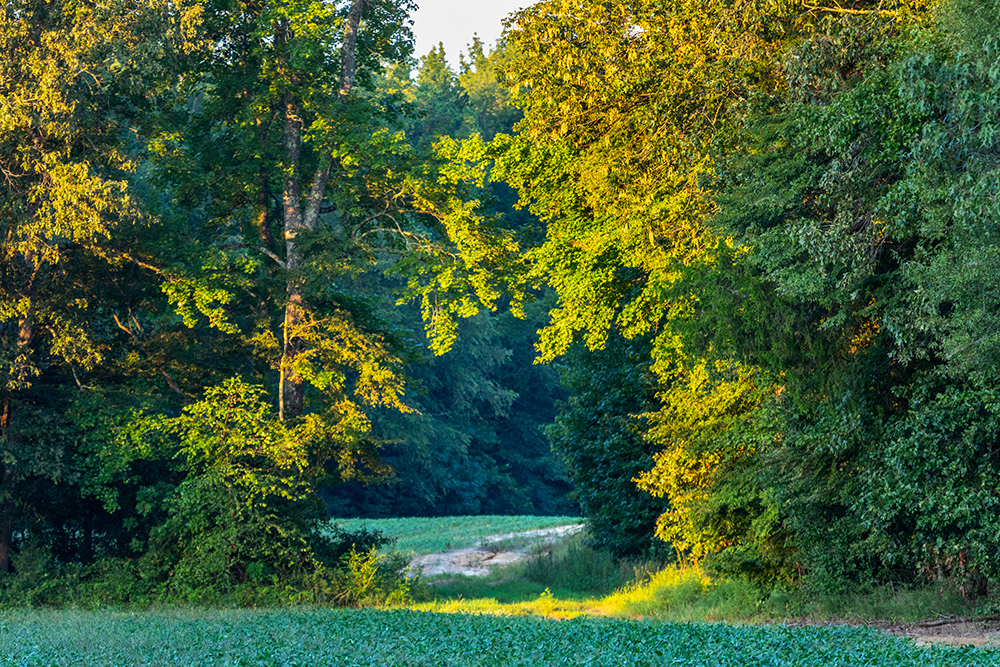
In an interview Faulkner explained that “in August in Mississippi there’s a few days somewhere about the middle of the month when suddenly there’s a foretaste of fall, it’s cool, there’s a lambence, a soft, a luminous quality to the light, as though it came not from just today but from back in the old classic times.”
This photograph was taken on my twentieth visit to the farm. My goal was to follow the light. It led me off the walkway to the soybean field, where treetops bathed in orange sunshine. I waited for the light to reach the ground.
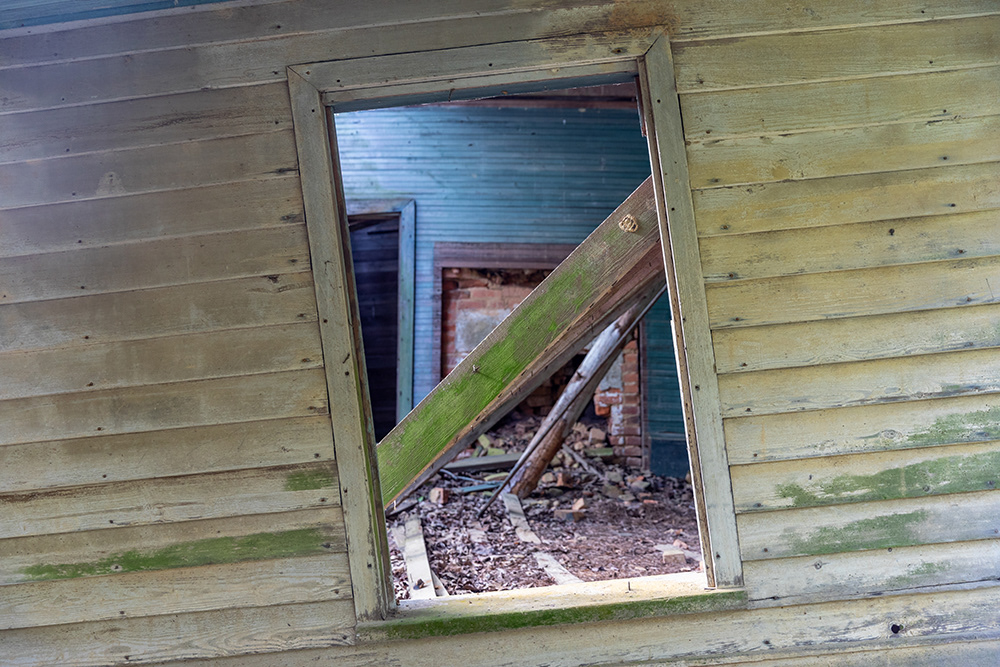
The farmhouse windows were bare, which allowed me to see deep into the interior. This window on the west side was interesting. The roof above the fireplace was destroyed, so sunlight spilled freely into the space, illuminating the paneling and blue paint. The color complemented the green fungus on the fallen beam and the faded green paint of the exterior wall. The distorted state of the farmhouse created slopes across the structure. The window wall slanted left and the fireplace wall slanted right. It seemed in motion, like a ship on rough waters.
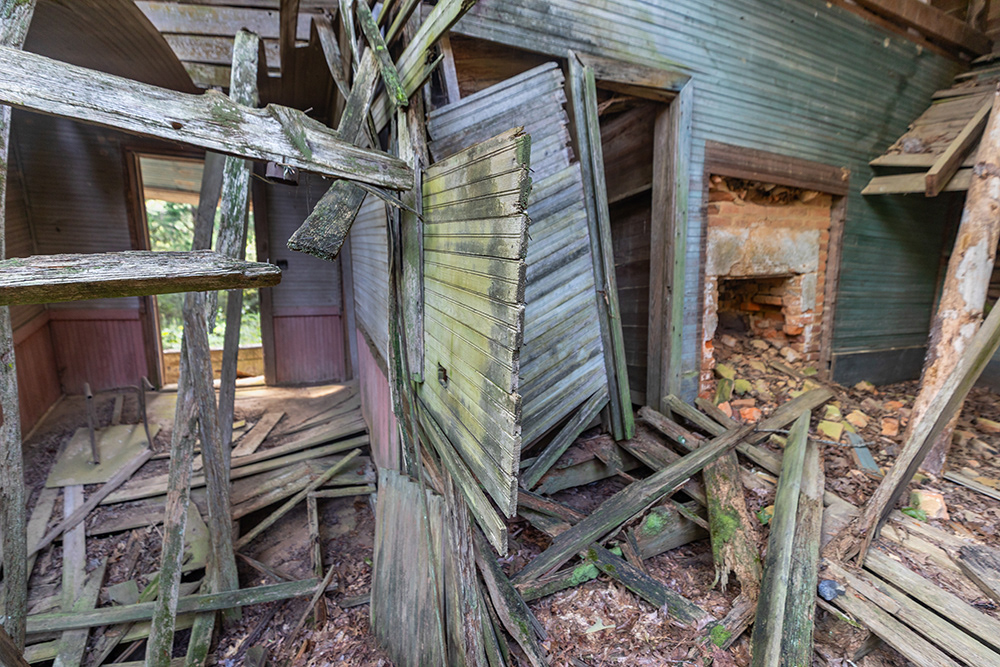
I never learned why or when the back end of the farmhouse collapsed, but its openness allowed me to explore the shambles of what was once home to Faulkner’s younger brother, Johncy. He lived there with his wife, Dolly, and sons, Jimmy and Chooky, while he managed the farm from 1938-1940. On the flooring that survived, I found shreds of floral wallpaper and shattered glass. Where the floors caved, I encountered beds of leaves, returning grasses, and rusted nails sticking though boards that had fallen from the walls and ceiling. It held a strange beauty.
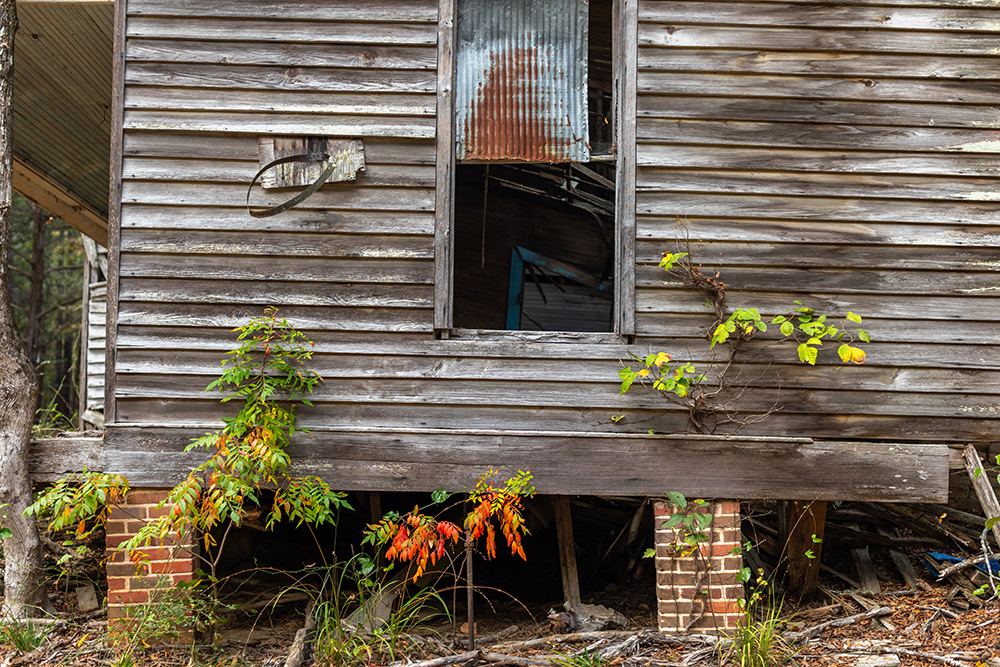
The homemade basketball goal was likely nailed to the farmhouse by Arenza “Renzi” McJunkins. He was born in 1911 on the land that would become Greenfield Farm and only left the property to fight in World War II. When Renzi returned in 1946, Faulkner chose him to manage the farm. His brother George McJunkins died in 1950, and Renzi took his widow and son, Bertha and Tommy, into his home, which was the farmhouse. He was the only tenant, along with Tommy, to appear in the 1952 Ford Foundation documentary about Faulkner, which was partly filmed at Greenfield Farm. Renzi McJunkins lived at the farmhouse until his death in 1969.
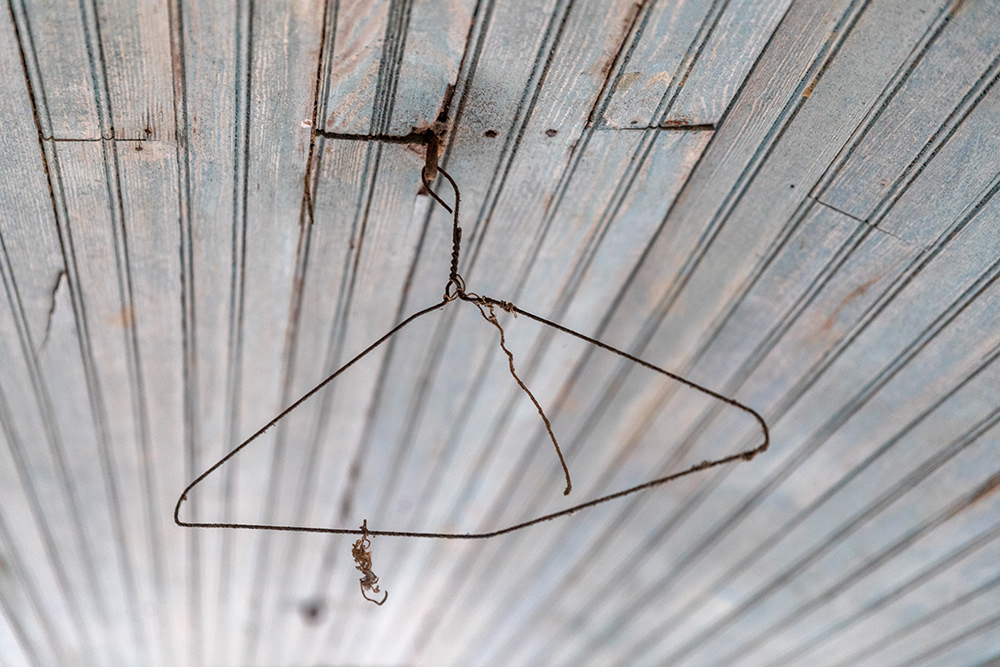
I walked the property with John T. Edge, Jim Gully, Brandon Presley, and Jason Bouldin. They wanted to see some of the artifacts that I had uncovered. The first thing I showed them was a shredded antique Chevrolet in the gully near the creek. Jason grew up on a farm and explained that most everything unwanted on a farm ended up in a gully. When I took them to the farmhouse and pointed to this dangling coat hanger on the front porch, no one could come up with a reason why it was there. The mystery was satisfying.
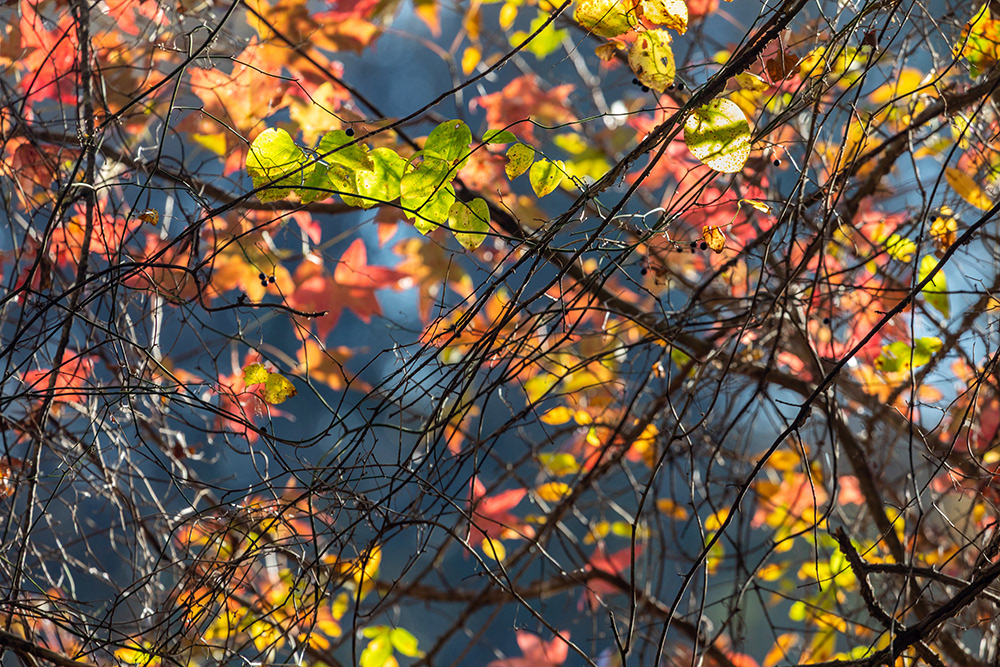
Fall at Greenfield Farm brought relief from the summer heat. The walkway and routes through the woods became more manageable. Biting bugs were less of a presence. The lush foliage that dominated the landscape surrendered to the shorter days and cooling temperatures. The leaves of deciduous trees changed from green to red, orange, and yellow. The farm’s isolation created a brilliant quiet that locked me into the environment. I experienced the seasonal changes emotionally like a drama, like entertainment.
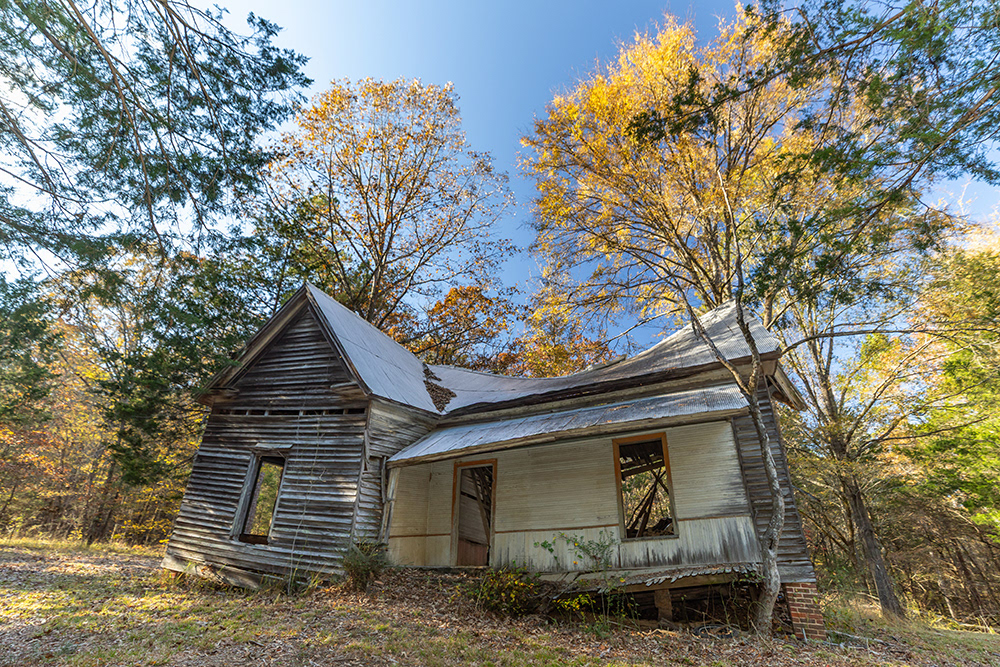
The farmhouse was the main character of Greenfield Farm. It pulled me up the walkway like a fish to a shiny lure. Trees seemed to push against the structure from all directions. That compression created a tension that I felt as walked onto the porch, passing an old dress shoe that had been there for years. I would sometimes ease inside though the front door or a window to explore and wonder why William Faulkner never boarded there when staying at the farm. He spent his time thirty yards or so up the walkway in what he called the “hunting lodge,” which burned to the ground around 1992.
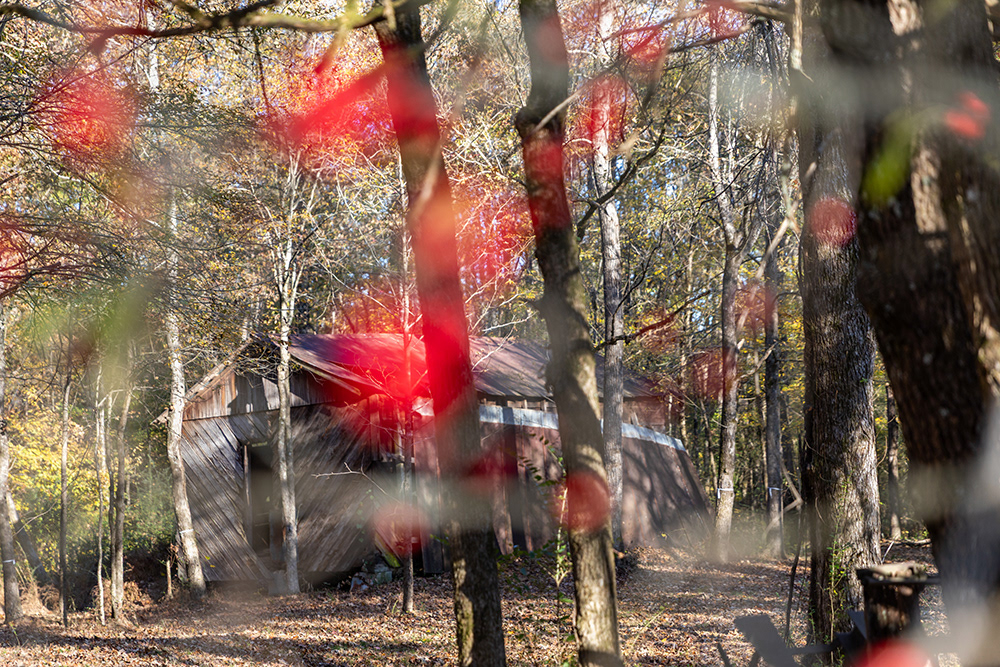
The Mississippi Lab wanted a record of the landscape, structures, and artifacts before it was transformed into Greenfield Farm Writers Residency. My main job was to collect documentary photographs, but I was also mindful to take poetic pictures that captured evocative imagery. Combining these aims into a single image was always a hope. Here, I stood near the old hay baler, before holly branches that I had never seen before. After documenting them, I focused on the corn crib, which distorted the fruit, making the berries shine like bright, blurry orbs. Perhaps, this was a spider’s point of view.
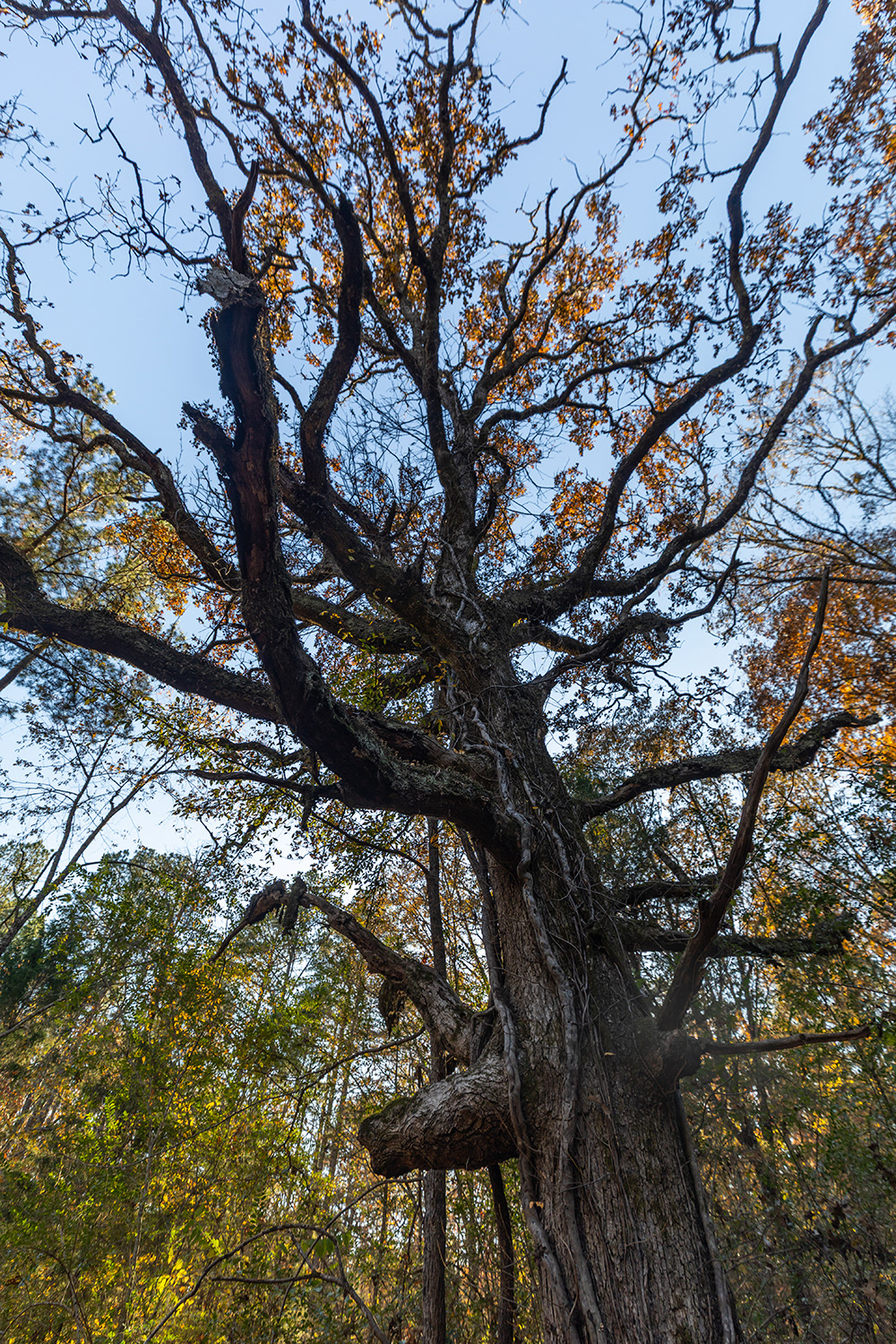
“It was a land of old, deep, thin mud, which was not just soil but a kind of history. It was a place of vast quiet, dark woods, where the air was heavy with the smell of pine and rain, and the only sounds were the distant call of a crow or the slow, thick, black, secret, and indifferent water of the river.” Intruder in the Dust
Greenfield Farm’s spectacular privacy influenced Faulkner’s Intruder in the Dust. I experienced that isolation when I walked the woods. It aroused my senses and stirred by imagination. I wondered how that quiet will affect the writers who come here to seek solitude when Greenfield Farm Writers Residency opens.
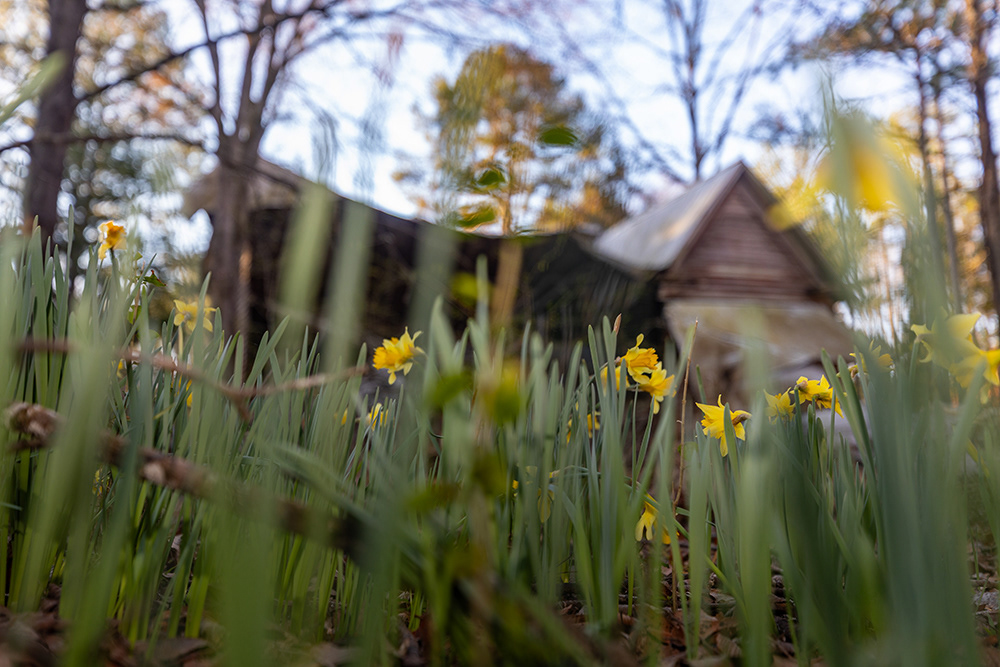
The daffodils that surrounded the farmhouse are the same variety native to England’s Lake District, where William Wordsworth lived when he wrote the poem “I Wandered Lonely as a Cloud,” which closes with these words: “And then my heart with pleasure fills, / And dances with the daffodils.” These daffodils are also known as lent lilies because they often bloom between Ash Wednesday and Easter.
I was surprised and pleased to come upon them. They added color to the landscape and made me think of people. Who planted them? How long ago? Were they here when Faulkner walked the farm? Probably so.
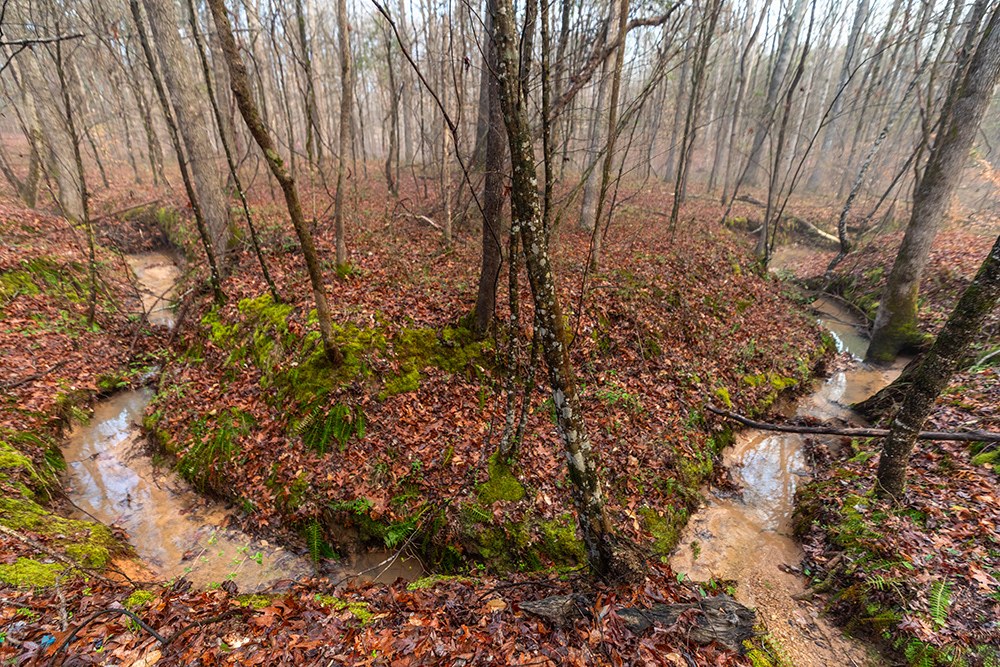
In 1949, MGM adapted Faulkner’s Intruder in the Dust into a motion picture. Four scenes were filmed at Greenfield Farm, including one at Puskus Creek, where a murdered boy is pulled out of quicksand.
Puskus Creek is about eleven miles long. Like Greenfield Farm, the creek is part of the Holly Springs National Forest. Its name comes from a Choctaw word that means “baby”. Branches of Puskus Creek snaked across the east side of the property and were fed by underground springs. This photograph was taken on a rainy day. Moss and Christmas ferns added rich greens to the winter landscape.
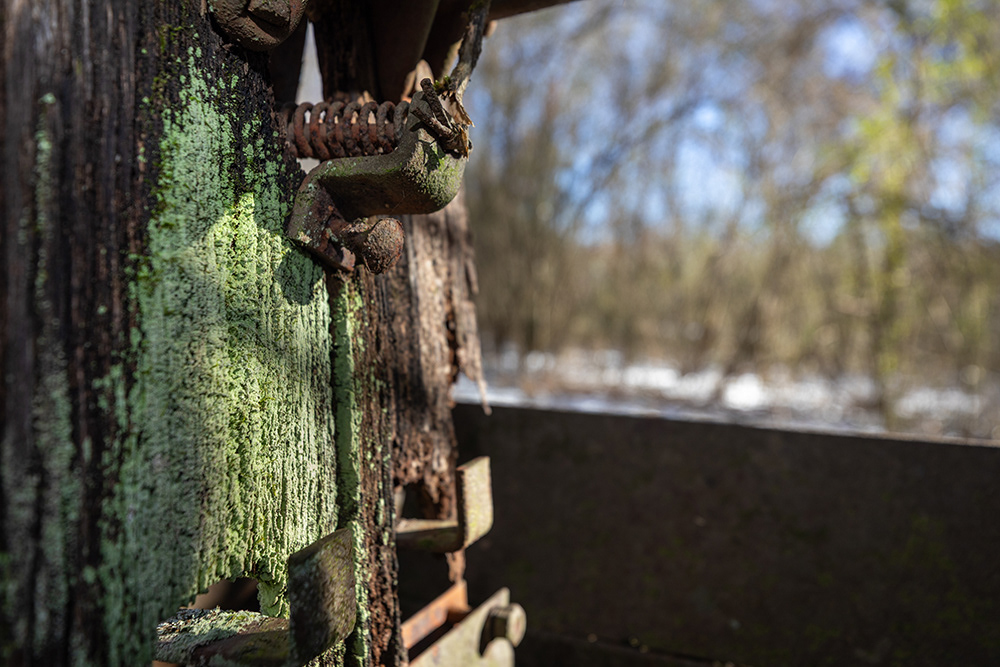
Green Rot on Hay Baler / January 11, 2025, 2:22 PM
The hay baler was a stone’s throw from the corn crib, and together they created a balance that allowed me to envision the bygone working farm. They were located near the now-demolished barn.
The hay baler was the farm’s most dazzling relic, wedged between trees that will only let it go when they go. Much of its metal wheels were buried by earth. Moss grew on its gears, frozen by corrosion. In this image, white light warmed the machine’s wooden frame, which connected the plunger components that rammed hay into compacted blocks. It had stormed three days earlier. Snow cradled the ground.
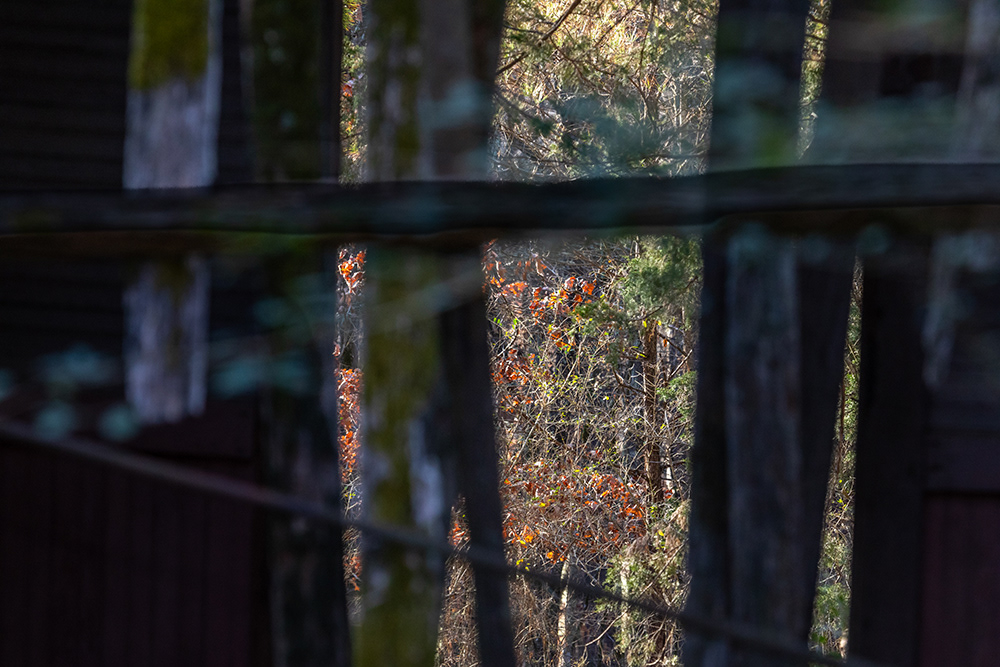
Sometimes a Faulkner book cover would pop into my mind when I photographed a subject. This image reminded me of Vintage’s 1990 paperback version of As I Lay Dying. Instead of seeing Addie Bundren in the damaged coffin, I saw her deathbed perspective. This was the version of the book I read for a high school class called Mississippi Writers. It inspired a group project film that I made with two other students titled "Infactuation of Death Among Mississippi Writers". After the film screened, as I was leaving the room, our teacher informed me that we misspelled Infatuation.
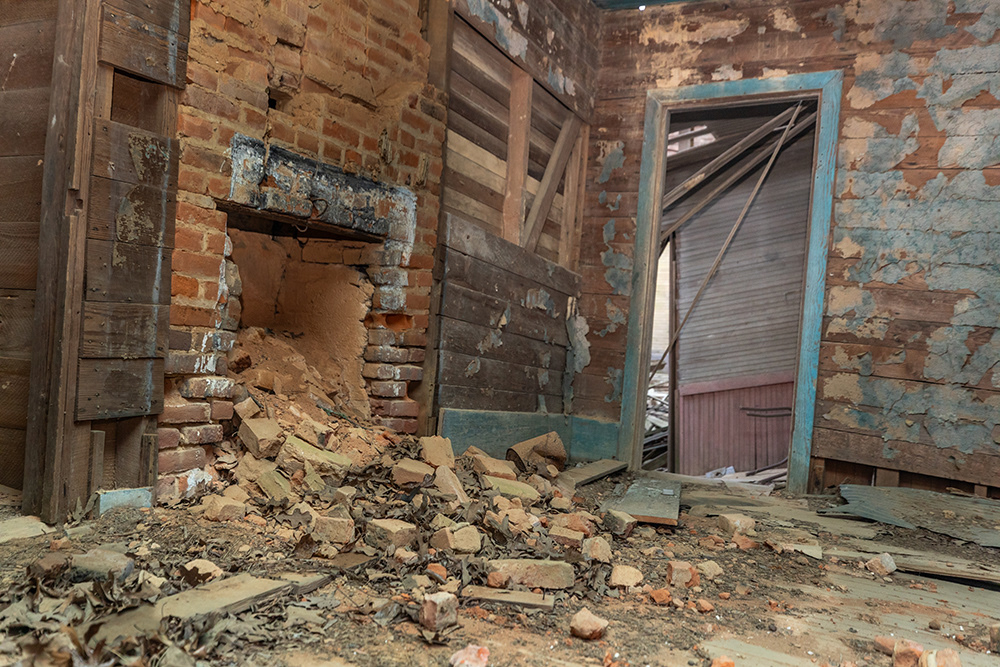
There were two fireplaces in the farmhouse. One warmed what was likely the den and the other heated the bedroom adjacent to the front door. They seemed to hold up what remained of the structure. The one in this photograph braced the only room that still had four walls. Much of its once-brilliant blue paint had flaked to the floor, where it mixed with red bricks, window shards, detached boards, and tree shadows cast by late afternoon sunlight. Somehow, the coat of blue paint on the ceiling endured.
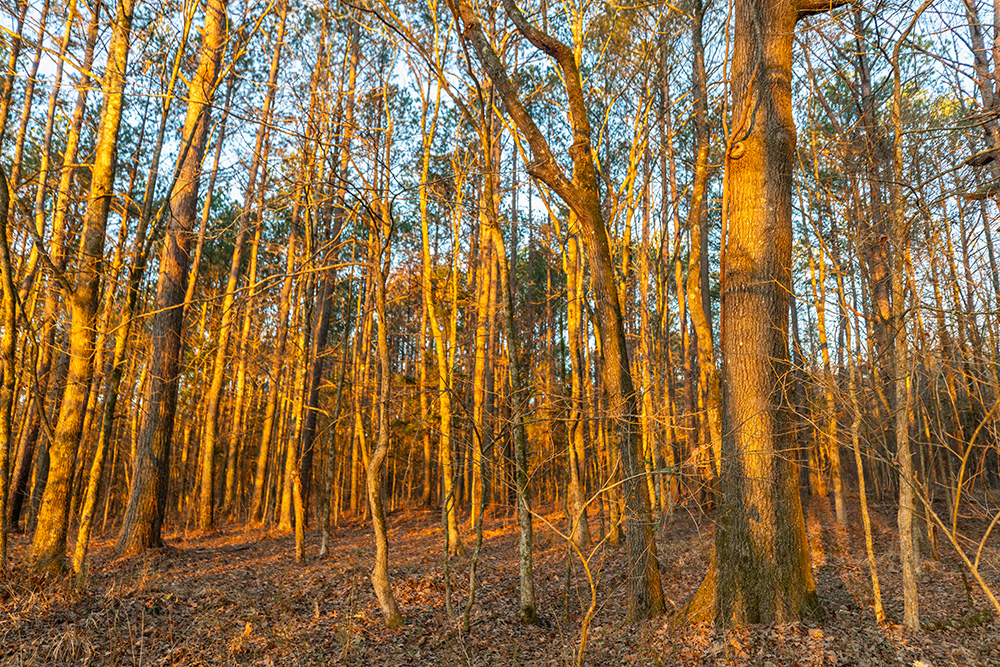
Trees were quiet, dignified spectators that kept watch over Greenfield Farm. At times, they stopped me in my tracks, particularly when struck by delicate light. I took this photograph during my first dawn visit. I had no idea where the sun would appear and was relieved to see it rise above the creek behind the corn crib. Ten minutes later, I spotted gold light on the trees beside the soybean field and hurried to these hardwoods. Because the field was vast and flat, sunrise touched this woodland edge like no other place on Greenfield Farm. Light bounced off wood like a song.